The Invisible Drain: How Trimble SiteVision 2026.10 Redefines Site Visualisation
Insights from BuildingPoint’s Aaron Cartridge on the unignorable necessity of collaborative visualisation—and the invisible cost hitting your balance sheet.

Insights from BuildingPoint’s Aaron Cartridge on the unignorable necessity of collaborative visualisation—and the invisible cost hitting your balance sheet.
You run a disciplined coordination process, your BIM is robust, your pre-construction meetings are thorough, and yet, on most projects, you’re still losing 5–15% of your built-in programme contingency to issues the design team had already resolved in the model three months earlier.
A mechanical duct clashes with electrical conduit at ceiling level, your frame is already in, rework takes eight days, and this is all before the inevitable subcontractor friction that follows. A structural corner doesn’t quite match the architect’s intent, and the client notices during handover inspection. You negotiate a scope clarification (read: change order negotiation), all for your commercial team to spend two weeks on a problem that should have been verified in week three.
The problem usually isn’t that the coordination work has failed. It’s that the design intent is locked in the model, while the people making real-time decisions on-site need something clearer, faster and easier to act on.
What shows up in your contingency line
is a fraction of what's actually happening below the surface.
For principal contractors managing $200M+ in annual revenue, the impact of this gap depends on your vantage point:
In each case, the underlying issue is the same: the information exists, but it is not reaching the people who need to act on it quickly enough. So teams fall back on site visits, phone calls, manual measurements and delayed walkthroughs — all slow, disconnected ways to manage decisions that should be tied directly to your design data.
So how much is this coordination problem costing you, and what would it be worth to resolve it?
Why This Moment Matters
For the past decade, site verification has been reactive and disconnected. You either hire a surveyor, hope to spot the problems during a walkthrough, or hear about them when there’s rework. These approaches work, but they’re isolated from your actual project management system. The data lives in silos, and nothing flows back into your coordination process. Your subcontractors don’t see it. Your client never knows you caught and resolved the issue early.
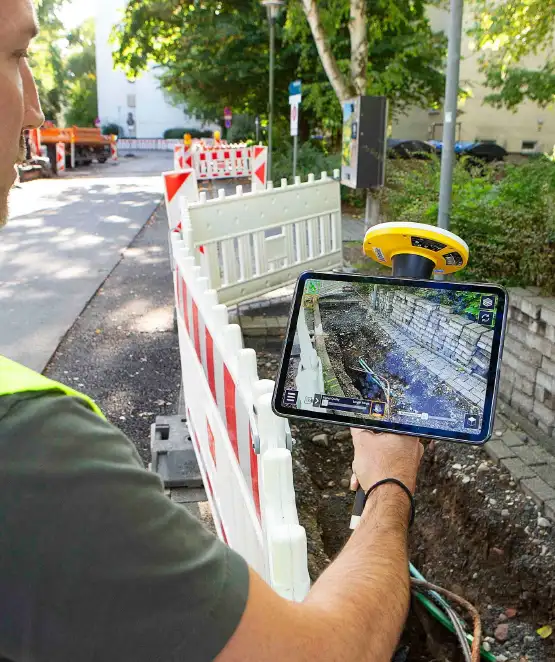
What’s changed isn’t just that lidar scanning got cheaper. It’s that you can now see your design intent overlaid on the physical site in real time—your BIM and your actual conditions visualised together at 1:1 scale, making verification visual and contextual, not abstract. SiteVision 2026.10 fuses accurate lidar scans with that AR capability and your existing project workflow in Trimble Connect, so verification becomes a management practice embedded in how you already collaborate—not a separate task that produces reports nobody uses.
Visibility becomes a management system, not an event. You’re not waiting for scheduled site inspections or specialist 3rd party contractors. Your project teams can verify conditions in real time, capture georeferenced point clouds, and sync that data directly into your project management platform. The field and the office aren’t two separate workflows anymore, they’re one integrated view.
Early detection becomes standard, not exceptional. When your structural frame is verified against the design before MEP trades arrive, clashes are resolved at the design phase, not the construction phase. Cost of change: $5,000–10,000. Cost of rework: $50,000–150,000.
Stakeholder management shifts from reactive to proactive. Your client sees verified conditions in context with the design, not a surprise during final inspection. Your subcontractors can see the real constraints before they commit resources. Scope clarifications happen early, not in change order negotiations.
Margin becomes predictable. Instead of budgeting for “coordination contingency,” you’re actively managing coordination risk in real time.
Let’s ground this in numbers that matter to your business.
Per-Project Cost of Late Coordination Issues
Most mid-size projects can easily see 2–4 coordination issues that slip into construction despite solid pre-construction work. That's $170,000–780,000 per project in unbudgeted coordination cost. Multiply that across your portfolio — a builder running 8–10 projects annually is carrying $1.4M–7.8M in annual coordination risk.
When You Catch It Changes Everything
Coordination issues happen — but shifting the decision point earlier is what keeps cost, disruption, and commercial risk manageable.
The return on investment is visible: even catching one issue per project in the early phase saves $35,000–135,000 per project. At an annual cost of ~$2,550 per user, you break even on the first issue on the first project.
Your structural frame is substantially complete. Before mechanical and electrical trades mobilise, your site team loads SiteVision, positions the BIM model against the actual structure using GNSS or QR markers, and captures a 3D lidar scan of the critical zones (ceiling grid, major penetrations, duct routes).
The scan is processed on-device in two minutes. Any variance from design shows immediately in colour-coded point cloud overlays. Your construction manager can spot the electrical conduit routing conflict before the MEP contractor has committed material and labour.
What changes: You're verifying at design confidence level, not discovery level.
Rely on subcontractor coordination meeting → wait for trade to mobilise → discover clash during rough-in → crisis meeting → rework.
Overlay MEP model 1:1 in structural zone → identify variance → notify design team in-app through BCF Topic → design solution before trade mobilisation.
Your project director needs to update the client on structural completion. Instead of a site walkthrough with the client looking at an unfinished ceiling, your commercial director logs into Trimble Connect Reality Capture Platform (where the point cloud has automatically synced) and shares a link showing the verified structural condition in context with the BIM model.
The client sees what’s been built and what’s remaining without setting foot on-site. They understand progress in context with the design intent. Scope clarifications that would normally emerge at final inspection are flagged during construction—when they’re cheap to address.
What changes: Client confidence moves from reactive (surprise at handover) to proactive (informed throughout construction).
Impact: Fewer scope clarification conversations, fewer change order negotiations, higher client satisfaction scores.
Your commercial director is managing a scope clarification conversation with the client over a finish detail that wasn’t clearly specified in the contract. Rather than relying on photographs or site descriptions, the team pulls up the relevant point cloud scan from the Trimble Reality Capture Platform, shows the client exactly what was built, and contextualises it against the design model.
The conversation shifts from “here’s what we think happened” to “here’s what actually happened, in context with the design intent.”
What changes: Change order negotiations are grounded in verified data, not argument.
Impact: Faster resolution, less litigation risk, clearer paper trail.
Addressing the Implementation Question
Senior leadership’s first instinct is often: “This sounds good, but will our teams actually use it?”
That’s the right question. Adoption hinges on two things:
The 4-step configuration wizard means your site managers can deploy SiteVision without IT support or specialist training. You’re not creating a new specialist skill—you’re enabling existing site teams to do verification work they’re already doing, but faster and with better data.
The integration question is real: if point clouds live in a separate system from your project workflow, adoption stalls. SiteVision solves this by syncing directly into Trimble Connect—which becomes a visual communication hub where your model, scans, and point clouds exist together in context.
When your site team identifies a variance using AR, they’re not generating a separate report. They’re capturing it in the same environment where your design team, commercial team, and subcontractors can see the exact same model, the exact same scan data, and the exact same context. A clash isn’t described in an email. It’s shown—your BIM overlaid on the point cloud, at 1:1 scale, visible to everyone who needs to make a decision.
That integration matters because it removes translation. Your construction manager doesn’t need to explain what they’re seeing. Your project director doesn’t need to interpret a report. Your subcontractor doesn’t need a separate briefing. Everyone sees the same visual reality.
The change management isn’t about learning new software—it’s about replacing email and site meetings with visual certainty.
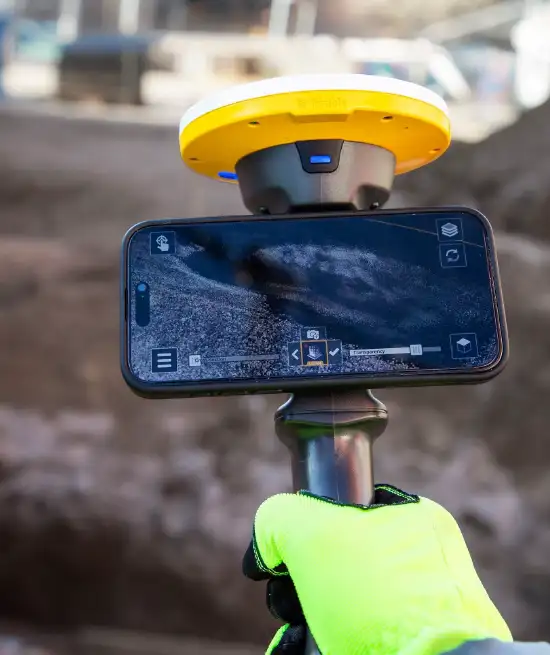
Previous versions of SiteVision were powerful for visualisation and client engagement. The 2026.10 release transforms it into a management system for site verification.
Key improvements:
For the leadership team, the critical upgrade is the integration story. Data flows automatically from field to office to stakeholders. That’s the difference between a verification tool and a management system.
The Broader Picture: Connected Construction
SiteVision 2026.10 is built on Trimble’s Connected Construction principle: verification data flows into the same ecosystem where your teams collaborate on project delivery. That means integration with your project collaboration tools, your construction management platform, your surveying workflows, and your field operations—creating a unified visual workspace instead of disconnected data silos.
For your organisation, this matters because:
You're not managing coordination risk on individual projects — you're managing it as a portfolio capability. Early detection patterns become visible across your business.
As your process matures, you can standardise verification workflows across all projects, all teams, all regions.
Clients, consultants, and subcontractors access the same data in the same platform. No separate systems, no translation layer.
That’s the vision that separates a tactical tool from a strategic capability.
Three Questions to Guide Your Next Step
If you’re managing $200M+ in annual revenue:
If any of those numbers feel significant, SiteVision is worth a 30-minute conversation with BuildingPoint.
Next Steps
BuildingPoint Australia delivers SiteVision with implementation support, training, and ongoing technical guidance. We work with your construction and commercial teams to scope the right pilot projects, ensure adoption, and scale the capability across your portfolio.
Schedule a conversation with our construction technology team to explore how SiteVision fits into your portfolio strategy and cost management approach.
Or reach out to your BuildingPoint account manager directly. We’ll walk you through a project scenario that matches your typical coordination challenges and show you the timeline and cost impact in context.
Aaron Cartridge helps construction professionals leverage field technology to improve productivity, collaboration, and project outcomes as BuildingPoint Australia’s Field Solutions Segment Manager. With 29+ years of construction industry experience and a practical understanding of construction workflows, he provides account management, technical expertise, and consultancy across BuildingPoint’s field solutions portfolio.
Fill out the form below to get in contact with one of our sales experts, or call to chat with our team.
Tech Support: If you are looking for Product Tech Support please do not use this form. Please visit our Support Page to contact us for support questions.
AUTHORISED PARTNERS


COMPANY
LEGAL
ADDITIONAL
HELP

 Why Digital Engineering Needs More Than Software Training